

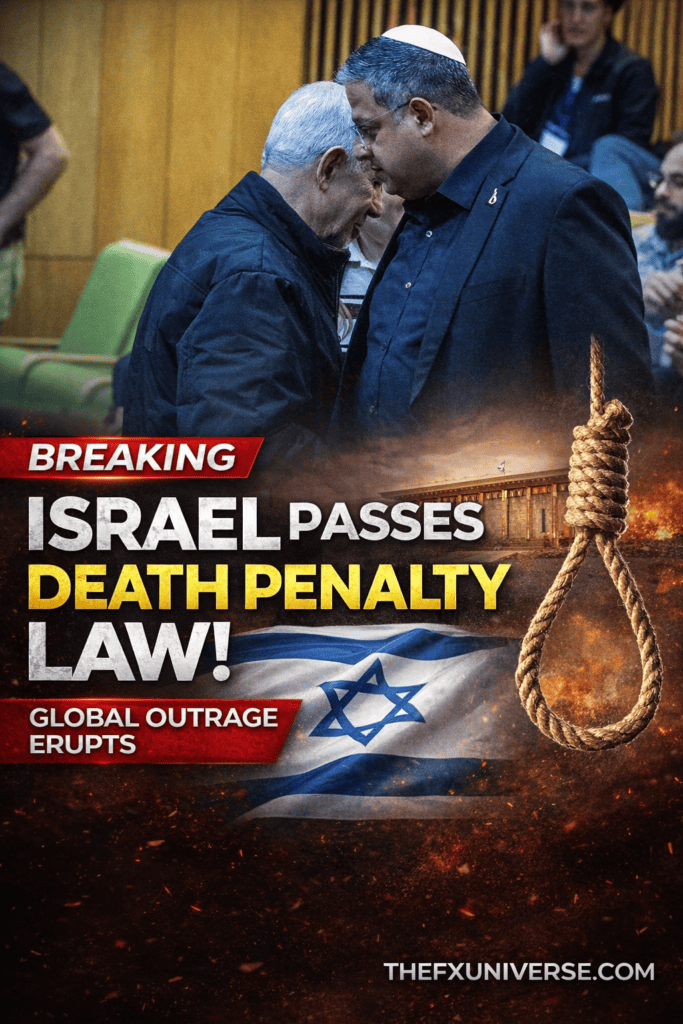
Leaders confront each other over Israel's new death penalty law, sparking international protests.
⚖️ Israel Passes Controversial Death Penalty Law – Sparks Global Outrage

Israel’s parliament has approved a highly controversial law introducing the death penalty for certain terror-related killings, triggering strong reactions across the world. The law is seen as one of the most significant legal shifts in Israel’s modern history.
📜 What the New Law Says
The legislation allows courts, particularly military courts, to impose the death penalty on individuals convicted of killing Israelis in what is defined as an act of terrorism. The punishment could be carried out within 90 days of sentencing, making it one of the strictest enforcement timelines. 0
In certain cases, courts may still choose life imprisonment instead of execution, but critics say the law is designed to make capital punishment more common.
👤 Political Push Behind the Law
The law was strongly backed by far-right leaders, including National Security Minister Itamar Ben-Gvir, who described it as a necessary step to deter attacks and show national strength. 1
Prime Minister Benjamin Netanyahu’s coalition supported the bill, marking a major political victory for hardline factions within the government.
⚠️ Why the Law Is Controversial
Critics argue that the law could disproportionately target Palestinians, as military courts primarily handle cases involving West Bank residents. 2
Human rights organizations and international observers have described the law as:
- Discriminatory in application
- A violation of international law
- Unlikely to reduce violence
Several countries including the UK, Germany, France, and Italy have warned that the law could undermine democratic principles and human rights standards. 3
🌍 Global Reaction
The law has drawn widespread criticism globally. European leaders and UN experts have condemned the move, calling it a step backward in human rights and justice.
Opponents fear that implementing the death penalty could escalate tensions in the already volatile Middle East and lead to further violence.
📊 Historical Context
Israel has rarely used the death penalty in its history. It was abolished for most crimes in 1954, and the last execution was carried out in 1962. 4
This new law marks a major shift away from decades of restraint and could redefine how justice is applied in conflict-related cases.
🔮 What Happens Next?
The law is expected to face legal challenges in Israel’s Supreme Court. Meanwhile, international pressure continues to mount as debates over human rights and security intensify.
As tensions rise, the world is closely watching how Israel implements this controversial policy and what impact it will have on the region.
About the Author