

Top Forex Trading Strategies & Techniques Explained
Forex trading refers to the purchase and sale of national currencies in a global, decentralised marketplace. Traders often rely on trading strategies that are based on the supply and demand of currencies, risk management and speculation by analysing market conditions. In this article, we cover the top forex trading techniques, tools and techniques you need to know.
Common Trading Strategies
There are different types of forex trading strategies based on different timeframes and risk appetites. Traders use different mechanisms under these strategies before making a decision.
1. Forex scalping strategy
This strategy works best on high liquidity currency pairs such as EUR/USD or GBP/USD during peak sessions. Investors aim to profit from minor price movements. There are three types of forex scalping strategies used by traders.
- Bollinger Bands: Traders use this strategy to measure the volatility of a currency by creating bands/ areas around the price.
- Moving Average Crossovers: This strategy is used to spot buy or sell signals in forex by watching when short and long-term averages ‘cross’ each other on a price chart.
- RSI/Stochastic: Traders use the Relative Strength Index (RSI) and Stochastic as ‘momentum meters’ on forex charts to spot when a currency pair is overbought or oversold.
2. Forex day trading
This involves opening and closing currency pair trading positions within the same day. It is also referred to as intra-day trading and is preferred by traders who want to avoid the fees associated with rolling positions over.
3. Forex swing trading
Traders use swing trading strategies to hold a position for days or weeks, aiming to capture larger market movements. Traders use stop-losses to manage exposure and is considered better for beginners or those who are only passively engaged in trading.
4. Forex position trading
This strategy involves holding currency pair positions over extended periods to capitalize on major price trends. Traders rely on fundamental analysis of economic data, interest rates, and geopolitical events.
5. Carry trade in forex strategy
Commonly referred to as FX carry trade, this strategy involves traders borrowing money from a country with low interest rates and invest it in a country with higher interest rates and profit from the difference. Key indicators used in this strategy are trend indicators, momentum tools such as Average Directional Index (ADX) and volatility gauges.
6. Trend trading strategy
Generally considered to be a mid-to-long-term trading strategy. Traders use technical indicators to identify the direction of market momentum. Trend traders implement both stops and limits to manage risks as the market can switch between uptrends, downtrends, and sideways trends.
7. Range trading strategy
Range trading in the Forex market is a mean-reversion strategy that assumes that currencies return to their historical average or mean. This is ideal for non-trending, range-bound phases where the exchange rate swings between defined support and resistance levels.
8. Price action trading strategy
Traders use different key levels, such as support and resistance levels and chart patterns to speculate future price direction and capture. There are three types of price action strategies that a trader implements based on the market movements:
- Price action continuation trading
- Price action breakout trading
- Price action retracement trading
9. Range trading forex strategy
Used in non-trending, sideways markets where currency prices swing between steady horizontal support and resistance levels. Traders identify the range using technical analysis and enter the market by buying at the support level or selling at the resistance level. Traders place stop-loss orders just below support or just above resistance to handle unexpected breakouts.
10. News trading forex strategy
Commonly used by day traders and scalpers, in a news trading strategy for forex, the traders focus on red-flag calendar items such as NFP, CPI, or rate decisions. The trades are placed in reaction to news announcements, which makes the market more volatile and high-risk in the short term.
11. Retracement trading forex strategy
This involves spotting temporary price reversals in an established trend. Traders use this point as entry points to join the trend at a more preferable price. Technical analysis tools such as Fibonacci retracements are used to determine the potential support and resistance levels. Traders place stop-loss and take-profit orders to minimise risk and ensure profitability when exiting a position.
12. Grid trading forex strategy
Traders create a ‘grid’ of orders by placing multiple stop-entry orders which are above and below the current market price. They select a base price, and space orders at fixed intervals, as per the market movement the orders are triggered.
Key Analysis Tools in Forex Trading
Traders use different analysis tools and concepts to build the best forex trading strategy. Some of the key tools and their uses are:
- Moving Average (MA) – This predicts the direction in which the current price trend is moving. It is also referred to as ‘simple moving average’ or SMA.
- Bollinger Bands – This measures market volatility and identifies potential breakout points.
- Average True Range (ATR) – This indicator is used to assist in setting a stop-loss order by measuring the volatility of the market.
- Moving Average Convergence / Divergence (MACD) – This detects changes in momentum by comparing two moving averages.
- Charts and Price Action – Candlestick charts are essential for studying price movements, patterns, and trends.
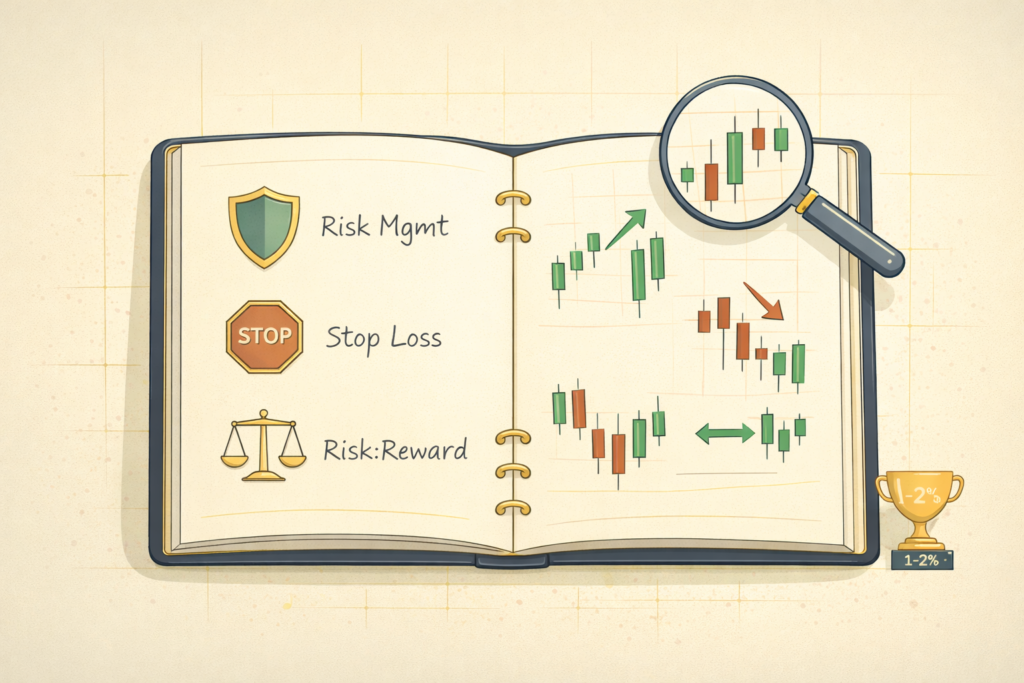
Risk Management Techniques in Forex Trading
To safeguard your trades from losses, it is important to be aware of forex trading techniques for risk management. Some of the core techniques used commonly are:
- 1-2% Risk Rule: Limit your exposure to 1-2% of your total trading money on one trade. For example, for an INR 10,000 account, the maximum exposure will be INR 100 to INR 200 by adjusting your position size correctly.
- Stop-Loss Orders: Place these types of orders beyond the support or resistance levels.
- Risk to Reward Ratio: Target 1:2+ ratio, filtering setups for positive expectancy over 100+ trades.
Common Mistakes to Avoid in Forex Trading
While we have focused on the best strategy for forex trading, it is important to know the common mistakes that most traders make during their forex trading journey.
- Poor Risk Management: As a trader, the best strategy for forex trading not only helps in securing profits but also avoids any vulnerability to risks. Successful traders ensure not risk more than 2 to 3% of their trading capital on any single trade.
- Emotional Trading Decisions: Trading based on emotions such as fear or greed could lead to early exits from profitable trades or holding a position for too long.
- Overtrading and overleverage: Trading too often can lead to higher spreads and commissions, which could add up to your capital amount. Using high leverage can be riskier, as a normal position could lead to a 5-10% loss in one go.
Conclusion
When it comes to choosing the best forex trading strategy, it’s important to choose a strategy that fits your objectives and allows you to discover profitability opportunities and reduce exposure to risk. A wealth account with DBS Bank provides personalized services that can help you build a portfolio that aligns with your financial goals.
Final thought from the desk: There’s no single “best” strategy — only what fits your personality, risk tolerance, and time commitment. Start with one, master it on demo, then go live with tiny size. The market rewards consistency, not complexity.
Pick your weapon, practice it 100 times, then talk to me about profits.
🚀 Step 1: Open a Trading Account (Any One)
- 🔹 Exness — https://one.exnesstrack.org/a/8holracys0
- 🔹 XM — https://affs.click/ljWB6
- 🔹 IUX — https://www.iuxmarkets.com/en/referral?code=nrUDq3X5
- 🔹 Vantage — https://ma.valetax.com/p/5800987
- 🔹 JustMarkets — https://one.justmarkets.link/a/qckhp0245d
About the Author