
What Is Forex Trading and How Does It Work?
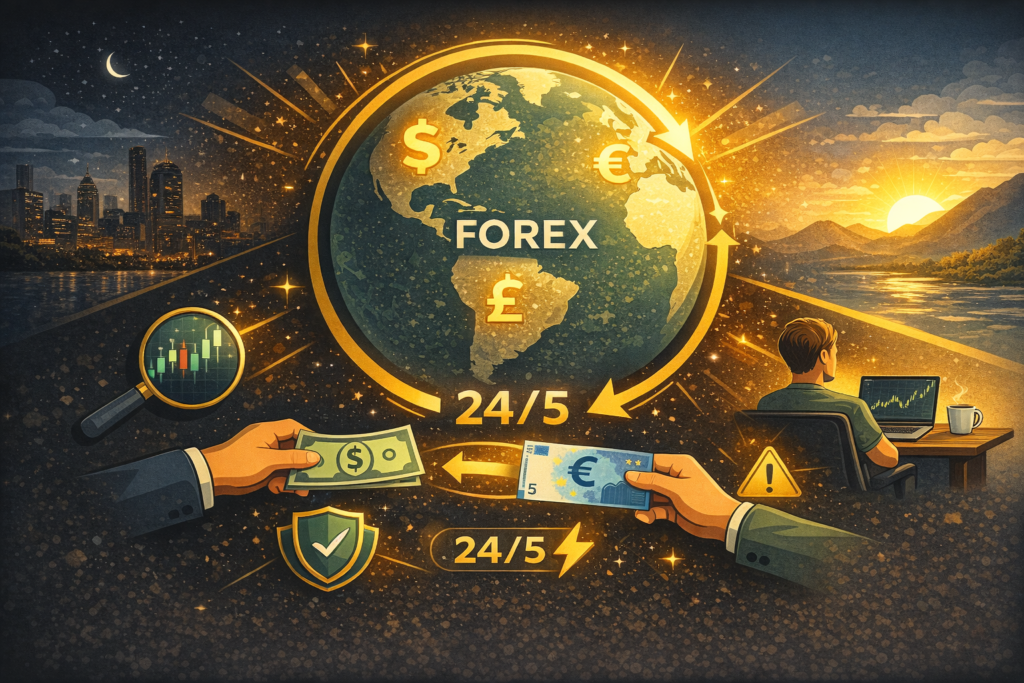
The foreign exchange (forex) market is a dynamic, global marketplace that is open virtually around the clock and sees more than $6 trillion change hands every day across the world’s central banks.
Investors, traders, and institutions use the forex market to hedge and speculate by exchanging one nation’s currency for another—trading currencies in pairs to take advantage of price shifts. Forex trading is not conducted on a central exchange, which means there is no physical location where all currencies trade. Instead, forex trades in a decentralized market that functions through a global network of financial institutions.
Foreign exchange rates are frequently fluctuating because forex is open nearly 24 hours per day and responsive to shifting supply and demand factors. Rates will also move based on numerous factors like global interest and inflation rates, macroeconomic and geopolitical conditions, and inflows and outflows of foreign capital.
Key Factors Every Trader Should Understand
Leverage
Forex trading involves leverage, meaning traders can take a position in a larger investment with a relatively small amount of initial capital. While this is enticing, leverage can magnify losses just as well as profits. A small amount of market movement can have a large effect—positive or negative—on an account’s profit and loss (P&L).
Margin
Leverage on a forex contract happens by trading on margin. A margin requirement, which acts like a good-faith cash deposit, is a fraction of the contract’s notional value. In forex trading, margin requirements vary as a percentage of the notional value. For a 3% margin trade, for example, a trader would initially commit $3,000 for exposure to $100,000 in the forex market.
(Very) Extended Trading Hours
The forex market trades almost 24 hours per day, 6 days per week (Sunday evening to Friday afternoon). Therefore, traders need to be responsive daily to market conditions and economic events.
Liquidity
Forex is a very active market with an extraordinary amount of trading volume, especially in the major currency pairs. Trading more exotic pairs, however, may present additional liquidity concerns.
How Trading Forex Currency Pairs Works
The forex market involves trading two currencies against each other as a pair, effectively buying one currency and selling another at the same time. They’re identified based on the symbol for the currency, such as EUR/USD (EUR for the euro and USD for the dollar). The EUR/USD pair is one of the most widely traded currency pairs.
A forex trader buying the EUR/USD pair would be long the euro (EUR) and short the U.S. dollar (USD), while a trader who sells EUR/USD would be short the euro and long the dollar. Other actively traded pairs include USD/JPY, GBP/USD, USD/CAD, AUD/USD, and NZD/USD.
Major Currency Pairs Typically Include:
- USD — U.S. dollar
- JPY — Japanese yen
- EUR — Euro
- AUD — Australian dollar
- NZD — New Zealand dollar
- CAD — Canadian dollar
- GBP — British pound
- CHF — Swiss franc
Any other currency pairs are generally considered “exotic”.
Currency Pair Pricing & Pips
Forex trading is measured by what are called pips, or “percentage in points.” For most currencies, a pip is equal to 1/100 of a cent, or 0.0001. One exception is JPY pairs, where the pip is equal to 0.01.
For example, if the quote for the EUR/USD trade is a 1.4168 bid to a 1.4170 ask (and one pip is 0.0001), the difference in price between the bid and ask is two pips. Like traditional stock traders, forex traders buy at the ask and sell at the bid.
⚠️ Important: Forex currency pairs trade in increments of 10,000 units (“mini lots”) or 100,000 units (standard lots). The cost of the trade is reflected in the bid/ask spread — the difference between the buying price of one currency and the selling price of the other.
Evaluating Forex Trading Risks
Because of factors like leverage and overnight trading—which makes it impossible to constantly monitor trades—a trader should carefully consider and assess their risk tolerance before considering forex.
One way to assess risk is through technical analysis, and many of the same techniques and indicators used to trade equities can also be applied to forex charts. Even simple trendlines can potentially be useful when looking for the next major trend in a currency pair, although past performance is not a guarantee of future results.
While technical analysis can provide insight, it shouldn’t be the only tool used to evaluate trades because trends can change at any time as prices fluctuate. Traders should consider using various analytical tools to make decisions.
Portfolio Diversification
Trading currencies can also provide portfolio diversification. It’s another asset class and another opportunity to initiate positions to build a portfolio. For example, an investor’s stock portfolio might not be doing well, and some of the losses might be offset by positive results from a profitable currency position. However, forex trading also has its own risks, and diversification does not guarantee against investment loss.
Assessing Potential Forex Trading Opportunities
The forex market offers both short- and long-term potential trading opportunities, with holding periods ostensibly ranging from a few minutes to several years.
- Short-term traders might focus on fundamental factors like interest rates and economic data, trading on information from news releases in search of intraday price movements.
- Long-term, buy-and-hold traders might use fundamental analysis to analyze opportunities by monitoring monetary policy, geopolitical stability, trade balances, and more. Longer-term traders may also want to focus on currencies from stable political and economic environments versus emerging economies.
How to Get Started
To start trading forex, traders need to open a standard brokerage account. The brokerage account can either be an individual, joint, corporate, LLC, trust, partnership, or sole proprietorship and needs to be approved for margin privileges. Once the brokerage account is opened and enabled for margin privileges, traders can then apply for forex access.
Once approved, traders can use trading platforms to monitor the forex market, plan strategy, and implement their forex trades.
Conclusion
Forex trading offers unparalleled liquidity, 24-hour access, and the ability to profit in both rising and falling markets. But it also comes with significant risks — especially leverage and the need for constant risk management. Whether you’re a day trader looking for quick moves or a long-term investor seeking portfolio diversification, forex can be a powerful addition to your trading toolkit. But remember: start with a demo account, master risk management, and never trade money you can’t afford to lose.
Final thought from the desk: Forex is the world’s largest financial market — $6 trillion daily, 24/5 access, endless opportunity. But leverage is a double-edged sword. Respect it, learn it on demo first, and protect your capital like a hawk. The market will always be here tomorrow.
Ready to start? Open a demo account below and practice for 30 days before going live. That’s how the pros do it.
🚀 Step 1: Open a Trading Account (Any One)
- 🔹 Exness — https://one.exnesstrack.org/a/8holracys0
- 🔹 XM — https://affs.click/ljWB6
- 🔹 IUX — https://www.iuxmarkets.com/en/referral?code=nrUDq3X5
- 🔹 Vantage — https://ma.valetax.com/p/5800987
- 🔹 JustMarkets — https://one.justmarkets.link/a/qckhp0245d
About the Author